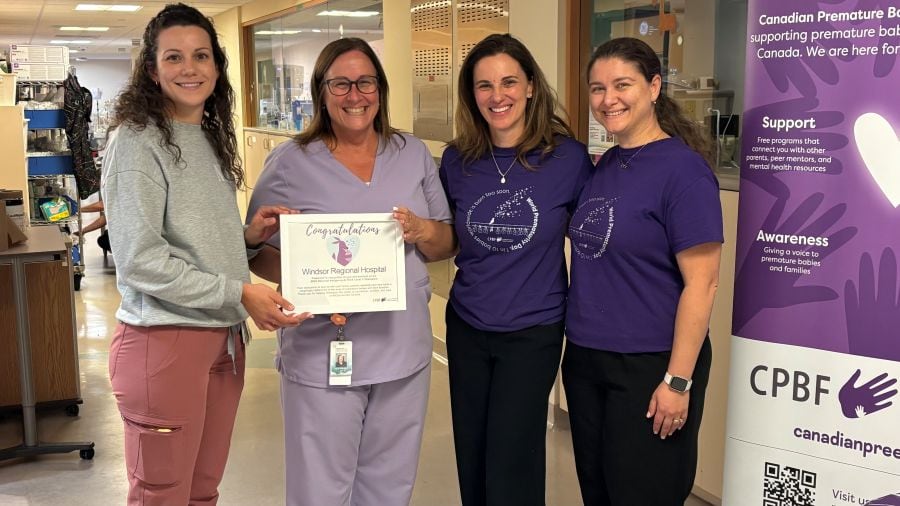
National recognition for Windsor Regional Hospital for its work in caring for premature babies and promoting skin-to-skin contact.
The Canadian Premature Babies Foundation (CPBF) presented the hospital Tuesday with an award for finishing first during the 2026 National Kangaroo-A-Thon—Level 2 category.
The Kangaroo-A-Thon was a month-long event designed to elevate the standard of neonatal care across Canada as hospitals tracked skin-to-skin care throughout the month-long campaign.
Kangaroo care is the practice of holding a premature infant skin-to-skin, diaper-only, against a parent’s bare chest, which functions as a multi-system medical intervention.
CPBF Executive Director Fabiana Bacchini says skin-to-skin contact really helps babies develop strong outcomes once they go home.
“It helps them to regulate their temperature and their heart rate and increases breastfeeding rates,” she says. “It also supports maternal mental health. We know through research that babies can benefit from skin-to-skin up to the age of 18.”
Windsor Regional Hospital’s Neonatal Intensive Care Unit (NICU) was grouped with 22 other Level 2 NICUs and accumulated a total of 750 hours of kangaroo time in 14 days, finishing well above the second-place hospital.
Bacchini says it is a difficult practice to provide skin-to-skin contact for premature babies who need an incubator.
“Those babies are not full-term babies where you can just pick them up from the crib and hold them whenever you want. Those babies are fragile; they have lines and respiratory support. It takes a team effort to bring the babies out, so this is why we are celebrating here,” she says.

Barbara Sadai had her daughter Scottie 10 weeks early on April 7 and spent seven weeks in the hospital. She says getting that skin-to-skin contact was huge for Scottie and her.
“It’s so hard to be connected to her when, like what they were saying, she’s on every tube, she had a chest tube, she’s intubated, she’s kind of on everything,” she says. “The only real connection you can have with her is to be able to hold her and have her on your skin and just be able to feel her breathing, her warmth, everything. It was definitely a different level of connection.”
In total, 49 hospitals across Canada participated in the competition.
Level 2 NICU (Special Care Nursery) manages moderately ill or stable premature infants who are generally born at or after 30 to 32 weeks gestation. They specialize in helping babies grow, gain weight, learn to feed, and transition off mild oxygen or brief intravenous support.
Up to 500 babies come through the hospital’s NICU each year.