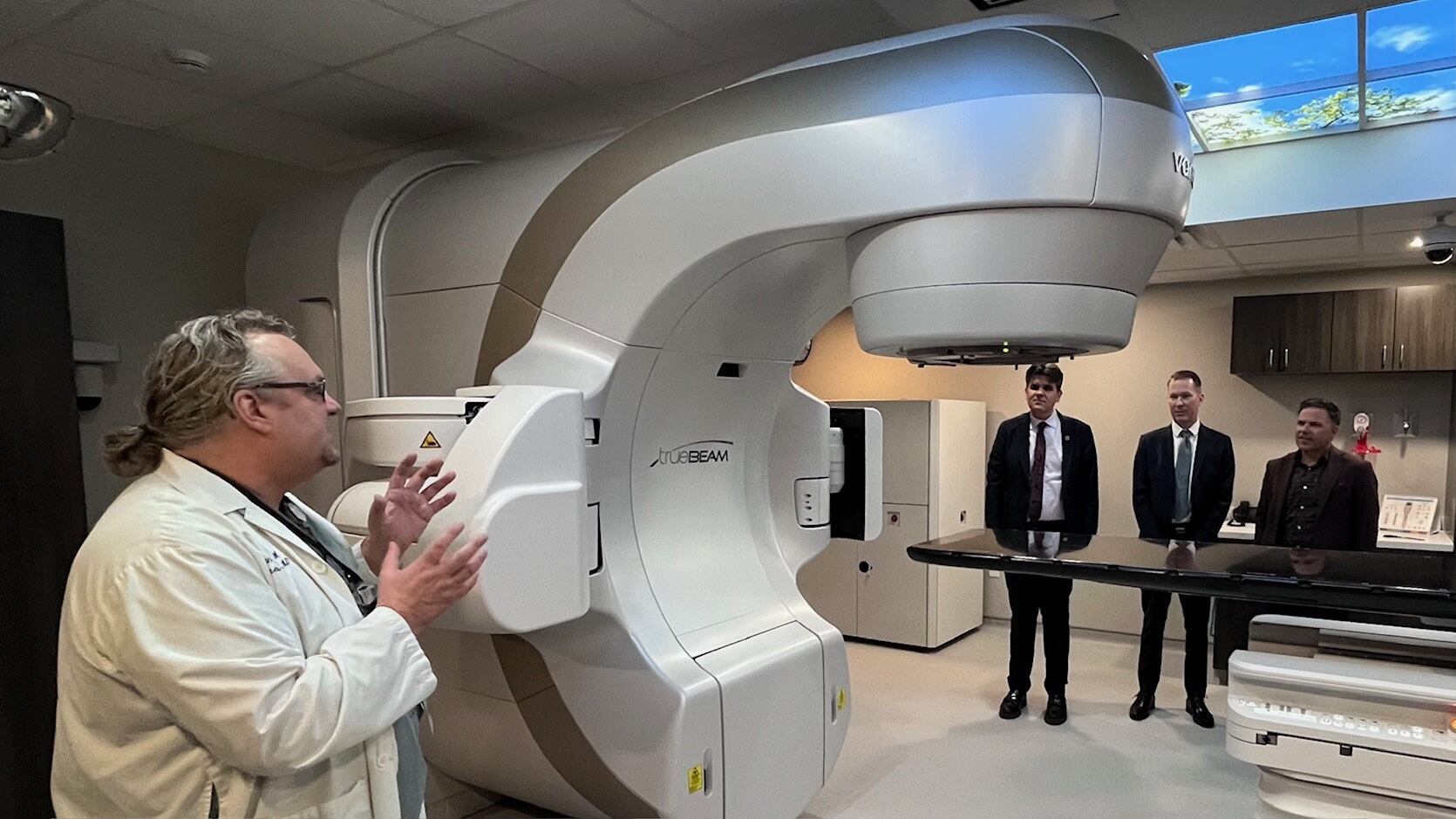
The Windsor Regional Cancer Centre will begin providing additional radiation treatments as of Tuesday thanks to new equipment now in place.
Windsor Regional Hospital announced Monday that construction is now complete on a fourth linear accelerator, or LINAC, to conduct radiation treatments on cancer centre patients.
The cancer centre was expanded to accommodate the new radation bunker and state-of-the-art accelerator, which will also allow the hospital to conduct necessary replacements of three existing machines over the next few years.
The hospital says at least three of the LINACs will be in operation at one time until all the existing ones are replaced.
Vice-President of Cancer Services, Jonathan Foster, says this will help them provide more radiation treatments beyond what's offered now.
"The three existing around 76,000 {a year}, give or take. There's some variability; that's just an average," he says. "This will give us another 26,000 on top of that. By the time we're done, we could potentially be delivering around 100,000 cancer treatments for radiation per year. That's not unique patients; that's individual treatments that take place throughout the year."
The new machines will be moved to the Windsor-Essex Regional Acute Care Hospital once construction is complete and it opens.
Foster says the wait times for treatment is currently under two weeks.
"There's a couple of milestones we look at. We look at it from referral to consult, and that's a two-week time frame that we've got. Then from consult or diagnosis to treatment initiation, we target two weeks as well. So we're hovering just under that two-week mark right now, which is really good because we are only operating with the three machines," he says.
Head of Radiation Oncology, Dr. Ken Schneider, says this latest technology can perform several forms of radiation treatment, including very focused treatments.
"By doing that, you can potentially increase the dose or give a shorter number of treatments that are higher per fraction of treatment. So you can get the dose to where it has to be in a shorter number of treatments, but you can also decrease the dose to the surrounding normal tissues. So outcomes can be better because you're giving a higher dose, and side effects can be less because you're not targeting normal tissue," he says.
The project was funded through a $30 million investment by the Ontario government that also included money to renovate the cardiac catheterization lab at the Ouellette Campus.
The Windsor Regional Cancer Centre is located at 2220 Kildare Rd. in Windsor.