If you’re a kid, a great neighbourhood doesn’t start with statistics.
It might be a patch of trees that feels like a fort, a quiet street where you can ride your bike or simply living next door to your best friend.
That idea sits at the heart of new research led by Emily Gemmell, a postdoctoral research fellow at the University of British Columbia, who helped create a national “playability” map measuring how supportive neighbourhoods are for young children’s outdoor play.
In an interview with CTV News Windsor, she explained that children don’t get exercise the way adults do.
“It’s not a thing that they’re thinking about and have as a value or a goal,” she said.
“Most of their physical activity is a byproduct of their engagement in play.”
The research focuses on children aged two to six and brings together open-source data mapped to postal codes across Canada.
Using five domains — spaces for play, social environments, traffic environments, natural environments and child-relevant destinations — researchers created a composite PlayScore that offers a high-level snapshot of how neighbourhoods support outdoor free play.
The results are available through an interactive online map, which allows users to zoom in on their own neighbourhood and see how different factors contribute to playability.
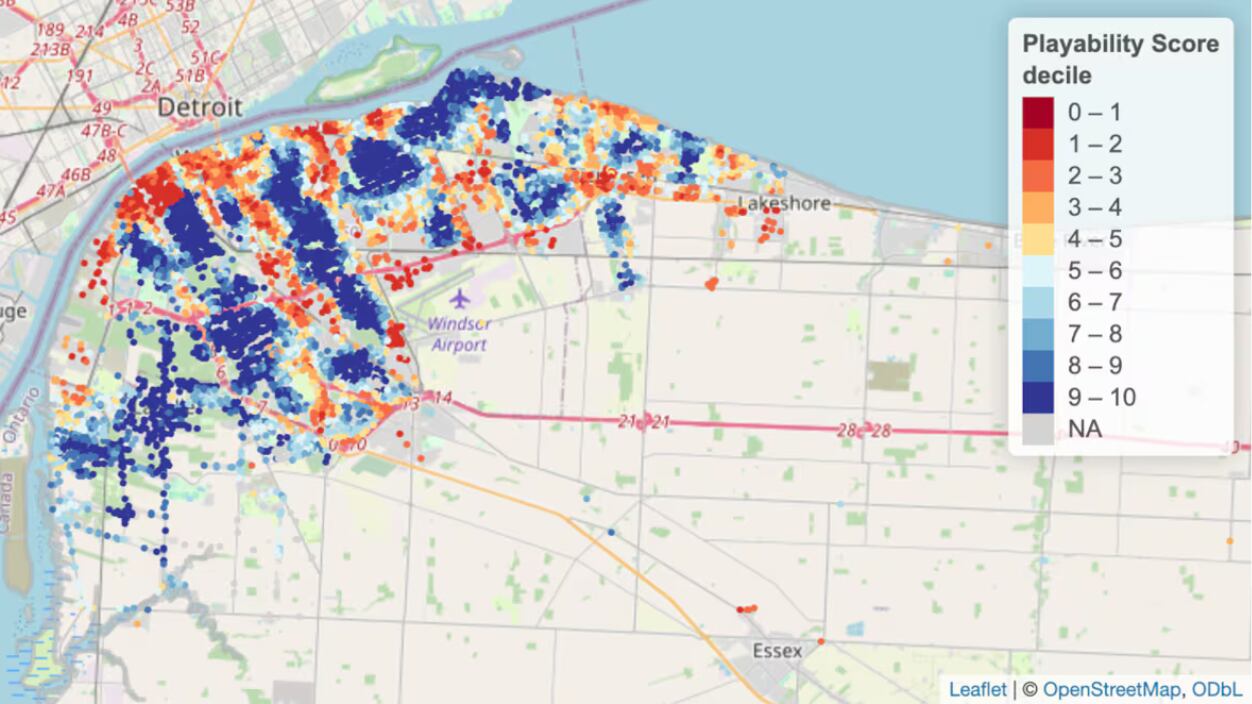
When it comes to Windsor, Gemmell says the data tells a familiar but important story: not all neighbourhoods function the same way for kids.
“Children within the same city might be growing up with completely different environmental supportiveness,” she said.
Overall, average playability across the Windsor metropolitan area ranks in the top ten when compared with 35 Canadian cities examined in the study. But Gemmell cautions against focusing on rankings between cities, noting that the biggest differences tend to show up block by block within the same community.
Traffic is one of the clearest examples. Even in neighbourhoods with nearby green space, access can be shaped by what sits between a child and the park.
“If there’s a beautiful park but it’s across a major road, that’s definitely a deterrent to accessing that regularly,” Gemmell said.
Those barriers matter, she adds, because outdoor play is a major source of physical activity in early childhood — and many kids aren’t getting enough of it.
“There’s a lot of concern about the amount of physical activity that children are getting,” she said.
“About 39 per cent of children in Canada meet the activity requirements. And those habits kind of begin in early childhood.”
The Windsor data also shows that playability isn’t driven by a single factor.
More materially advantaged neighbourhoods tended to score higher overall, often due to stronger natural, traffic and social environment scores.
At the same time, less affluent neighbourhoods frequently scored higher for access to play spaces and child-relevant destinations — highlighting how different aspects of playability are spread unevenly across the city.
Gemmell stresses the PlayScore isn’t meant to label “good” or “bad” neighbourhoods, or to replace lived experience.
Instead, she hopes it helps parents, planners and communities pause and ask a different question.
“My hope is that it would just raise awareness about looking at it through a child’s eyes,” she said.
“What are what are the things that would be interesting to me in this neighborhood and what would get me outside? Is it even possible for me to go outside my door and play?”
-Written by CTV Windsor's Travis Fortnum