Windsor Regional Hospital is touting a new specialized surgery for vascular patients that not only allows them to stay here for the surgery but also improves patient recovery times.
In October of 2022, WRH began performing Endovascular Aneurysm Repair (EVAR), and several other advanced hybrid techniques to manage aortic aneurysms - a potentially life-threatening issue involving the largest blood vessel in the body.
Previously, this complex problem was treated with a long operation that can include potentially life-threatening complications, blood loss, multiple nights in the Intensive Care unit, and up to a week or two in hospital.
The average open aortic surgery takes four hours to as long as 14 hours, but the surgeons here have reduced the procedure time down to around two hours by using this method.
With EVAR, the aneurysm is repaired using tiny punctures in the groin to insert special devices called stent grafts.
The grafts divert flow away from the aneurysm and eliminates the risk of rupture.
Vascular surgeon, Dr. Sowmil Mehta, says aortic surgery is one of the most complex surgeries you can have, both from the surgeon's perspective in performing the procedure and from the patient's perspective when it comes to recovery.
"You an picture a large abdominal incision versus two small incisions in the groins. It's a big difference in terms of the pain involved, wound management, wound infection rates are going down, the burden on the family. So there's a lot of issues we think have improved," he says.
While receiving care locally, EVAR will help improve procedural time, reduce ICU resources, and lower the length of stay in hospital for patients.
On average, a patients length of stay is 24 hours following EVAR, compared to 10 days following open repair.
It also allows patients to return back to their day-to-day life just a few days after the procedure is completed.
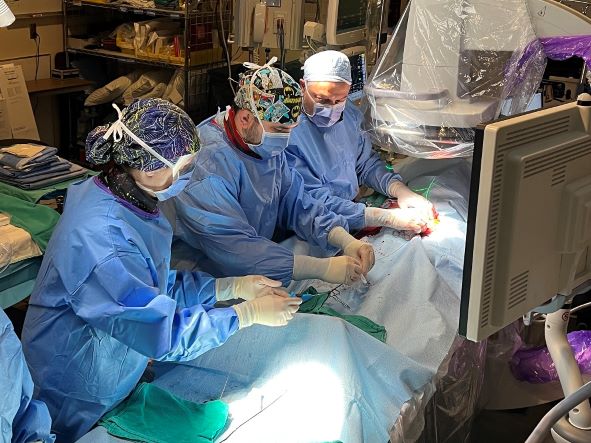
Surgeons at Windsor Regional Hospital perform an endovascular aneurysm repair. (Image courtesy of Windsor Regional Hospital)
Vascular surgeon, Dr. Maher Sabalbal, says one of the best parts of the EVAR approach is that you no longer have to unzip the patient from their chest to their public bone, and cutting through their abdomen and bowels to reach the aneurysm.
"We do everything under ultrasound guidance and the patients are left with a half a centimetre incision in their groin after all is said and done. Within a couple of days they're home and feeling 80 to 90 per cent. within two or three weeks, it's like nothing happened," he says.
Dr. Sabalbal says since October of 2022, they've been doing this procedure on two to four cases a month.
"We've done well over 20 cases now since this program started, which is a significant number. Our hope is that this becomes the standard of care for managing patients with aortic aneurysms and some other inclusive diseases and obstructions in the pelvis and abdomen," he adds.
On Jan. 23, WRH proceeded with a complex endovascular repair that is only done in a handful of academic hospitals in the country.