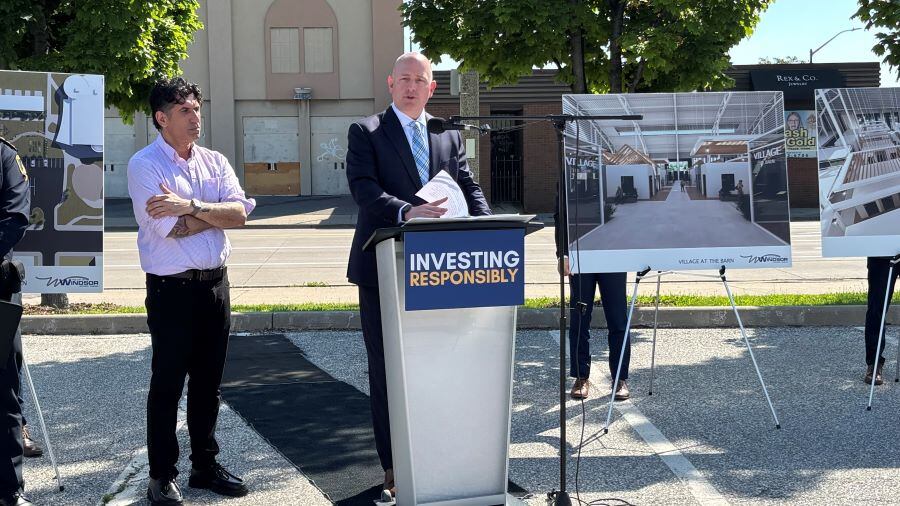
The city has unveiled a proposal to transform the former Windsor Arena into an indoor village to house and support people experiencing homelessness, mental health, or addiction issues in Windsor.
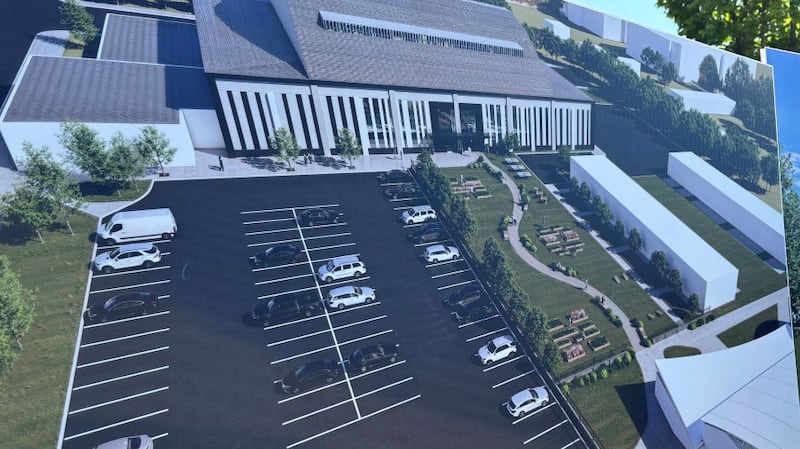
“The Village at The Barn” is described as a supportive pod-style village set up like a campus-style multi-building facility that would provide housing and wrap-around support services.
Mayor Drew Dilkens and Ward 3 Councillor Renaldo Agostino unveiled the proposal during a news conference Wednesday outside the area at the corner of McDougall Street and Wyandotte Street East.
The proposal calls for renovations inside the old arena to provide 102 private, lockable dwellings located within a larger, secure structure.
There would also be a common lounge, communal gathering areas, a community activity room, restrooms and shower facilities, a clinical intake and examination area, administrative, casework, and counselling rooms, access to a safer use space for residents, laundry facilities, space for future growth, programming, education, and outdoor greenspace shared with the city’s Homelessness and Housing Help Hub, or H4.
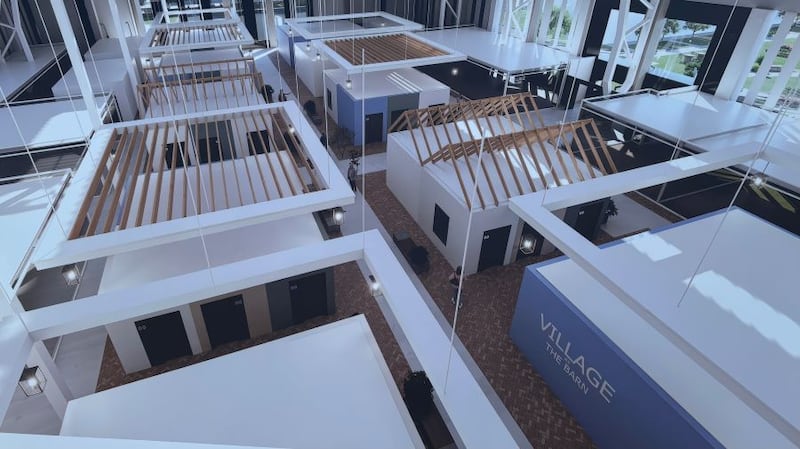
The concept is being modelled after Avivo Village in Minneapolis, Minnesota, a low-barrier transitional housing sanctuary that offers 100 private units and holistic support services in a repurposed former industrial warehouse.
Dilkens says they think what they saw at Avivo Village in Minneapolis can work at Windsor Arena in coordination with the H4.
“Deliver supports and services for people experiencing mental health and addiction downtown, taking them where they’re at, giving them a place to put their head on a bed, getting them off our main street and other streets, allowing them to live their lives, but also getting the supports they need to get on a pathway to recovery,” he says.
Agostino says people need a space of their own where they feel dignified; that’s the first step toward getting better.
“I’m a nut bag. If I didn’t have a place to go and sit there to be with my thoughts, relax, and chill out, I can’t imagine where I would be,” he says. “Now imagine not having access to shelter, not having access to food or showers or bathrooms, and then being in that same mind space.”
The exact cost to make the project happen is not yet available.
Dilkens says the city is prepared to invest money into this, but they can’t do it without federal and provincial financial support, something they will be seeking.
“We expect to have at least a high-level estimate sometime in June, and that will drive a report to city council where city council can have a very thorough and thoughtful conversation on this particular plan and give some guidance and direction moving forward,” he says.
Agostino says it’s going to take support to get this done.
“It’s going to take council support. It’s going to take the mayor’s support, and it’s going to take the provincial and federal government’s support. I can tell you, I’m very, very confident that those are all locked in,” he says.
In order to access the rooms, services, and supports, residents would be required to contribute to the cost of service, including funding through programs like Ontario Works or the Ontario Disability Support Program (ODSP), to help cover room and board.
The city plans to prioritize the highest-need individuals when considering access to one of the pods within the village.
Agostino says we can’t ask people to just get better, stop doing drugs, or stop breaking into people’s cars without offering an olive branch.
“Now there’s an expectation; now there’s an opportunity to connect,” he says. “That’s what I saw the most out of Avivo-that it really changed people’s mindsets. I was like, ‘Wow, you’re giving me something nice?’ For most of these people, they’ve never been given anything nice in their entire lives.”
Dilkens says it gives people a chance to put their head on a bed and get the supports they need.
“While we have them here, whether it’s the restroom facilities, the shower facilities, the laundry facilities, or the food service, we have the ability to interact with them and get them off the street but also on a pathway to recovery. It’s different than anything else anyone is doing in Windsor,” he says.
“The Village at The Barn” would operate 24 hours a day, seven days a week, 365 days a year.
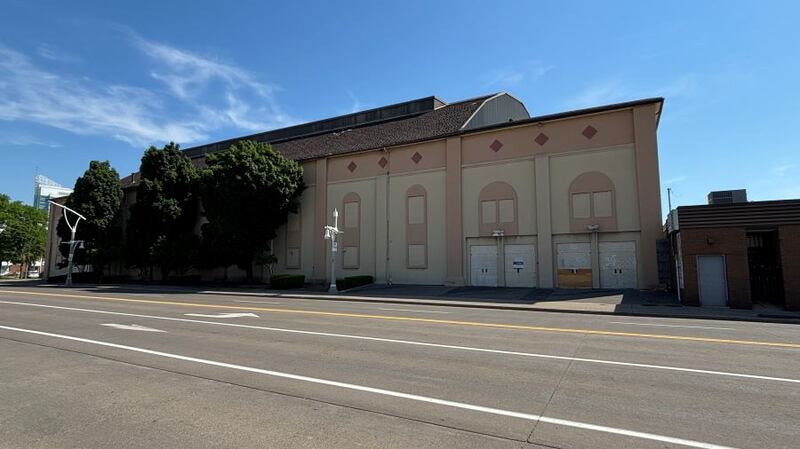
The arena at the corner of McDougall Avenue and Wyandotte Street East was built in 1927 but has been unused for several years after being permanently closed in 2012.
In early April, Dilkens said in his State of the City address that they were exploring the possibility of repurposing the former Windsor Arena to work along with the services offered by the city’s Homelessness and Housing Help Hub next door.