


OTTAWA -- Guns boomed, bagpipes wailed and CF-18 Hornets thundered overhead as Canadians paused at the National War Memorial in Ottawa on Wednesday to remember those who served and died defending this country.
This Remembrance Day comes just weeks after a deadly training accident at Canadian Forces Wainwright left four dead and dozens of other soldiers with burn injuries.
Sgt. Morgan Wong of Edmonton, Pte. Shaun Farrell of Prince Albert, Sask., Pte. Aidan Goulding of North Vancouver and Pte. Hayden Lykkemark of Langley, B.C., were killed at the Alberta training base last month.
They died and dozens of others were injured when strong winds suddenly swept up a grass fire that was burning on the automatic grenade launcher range and carried it across the training area.
“We mourn their loss, stand with those recovering from their injuries, and hold their families and fellow service members in our thoughts,” Prime Minister Mark Carney said in a media statement.
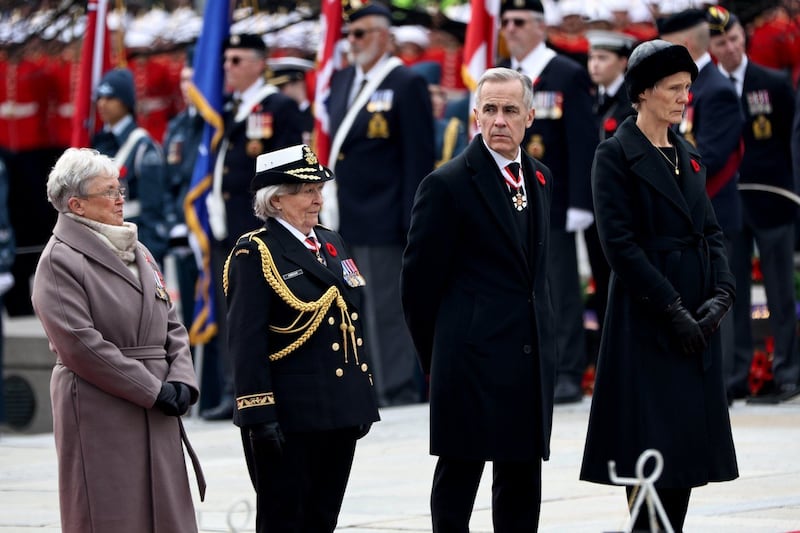
Gov. Gen. Louise Arbour said Canadians’ thoughts “remain with the soldiers we lost, those who were wounded, as well as the families, friends, comrades and all others affected by this tragic event.”
National Defence has said that, as of Nov. 4, 14 of the 39 injured had been released from hospital while another 25 remained in hospital.
Thoughts for Wainwright victims poured out from people across the country.
A prayer for the victims was read at the ceremony in Place du Canada in Montreal, as cannon fire rang in the air. In Toronto, Mayor Olivia Chow said she wished the injured “strength and healing.”
Hundreds gathered at an arena in Wainwright, Alta. for the local ceremony. They included Conservative Leader Pierre Poilievre, whose riding includes the training facility.
South of the border, Rear-Admiral Kristjan Monaghan spoke at the Canadian Embassy on Pennsylvania Avenue in Washington, D.C., about those who died in Alberta last month.
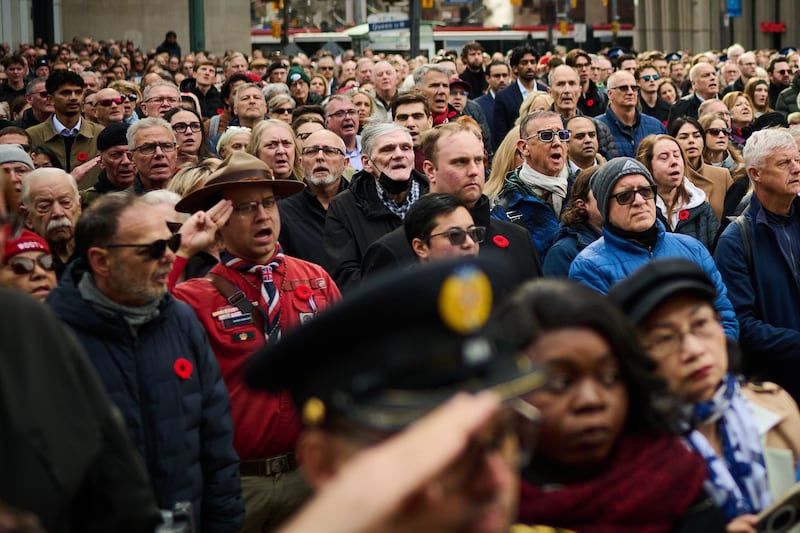
“The loss experienced there has been felt across the Canadian Forces family, across the nation and beyond,” Monaghan said.
“It reminds us that sacrifice is not defined solely by geography. Service members accept risks, not only when deployed overseas but also while preparing themselves to serve their country.”
Canadians are also marking a quarter-century this year since the Afghanistan war began. The war — the longest in Canadian history — stretched on for more than 12 years and involved some 40,000 Canadian Armed Forces members.
Veterans Affairs Canada said 158 Canadian Armed Forces members and seven Canadian civilians — a diplomat, four aid workers, a government contractor and a journalist — lost their lives in Afghanistan.
Ian Moffat, a retired Royal Canadian Navy commander who served for 41 years, said Wednesday he was thinking about a soldier who died in Afghanistan.
“When I was in Afghanistan, there was a young armoured soldier in her very early 20s who was killed by an [improvised explosive device],” he told The Canadian Press at the ceremony in Ottawa.
“If you saw her picture, you’d swear she wasn’t any older than 17. I was at the ramp ceremony when she was loaded on board and I’ve never forgotten that.”
Ray McGill of Courtice, Ont. came to Ottawa so he could proudly watch as his son marched in his first Remembrance Day parade after joining the military last year.
McGill said his job during the Afghanistan war was to notify next of kin when soldiers were killed.
“It’s a pretty powerful day and gives us an opportunity to come out and pay tribute to those who can’t be here today,” he said. ”Those guys gave their todays for our tomorrows.”
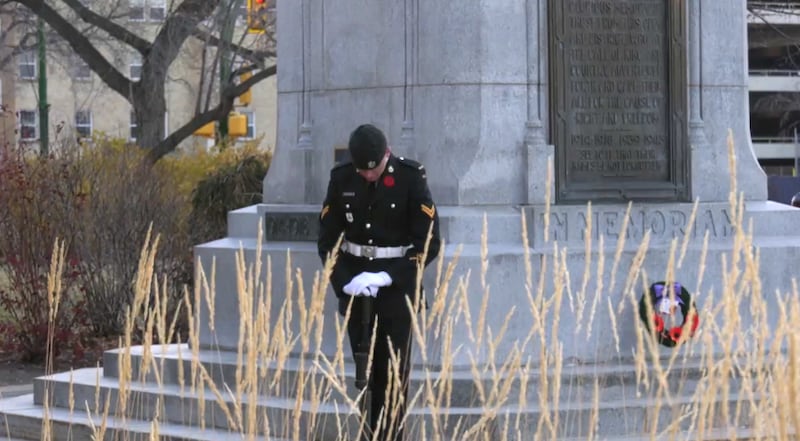
Kyle Scott, a Canadian Army veteran of the Afghanistan war who travelled to Ottawa from Alberta, said he was thinking about the comrades he served with who never made it home — and those who died after their return.
“I think of my own family and the troubles they faced when they returned from the First and Second World Wars,” he added.
“Life after service is often harder than when you are serving, so today has a lot of meaning.”
Marcel Huot, a Second World War veteran wounded twice in Normandy, was one of several veterans of that war who came out to the national ceremony.
He said he remembers a heavy barrage of artillery fire, “sand everywhere” and live fire directed at him. He recalled dropping to the ground to avoid the shelling before being hit in the back by a piece of shrapnel.
Huot said his thoughts are of his wife, who enjoyed coming out to the national remembrance ceremony.
“She died of Alzheimer’s. I’m lonely sometimes,” he said.
Veterans Affairs estimates the population of living Canadian veterans from the Second World War and the Korean War has dropped to approximately 4,306 people.
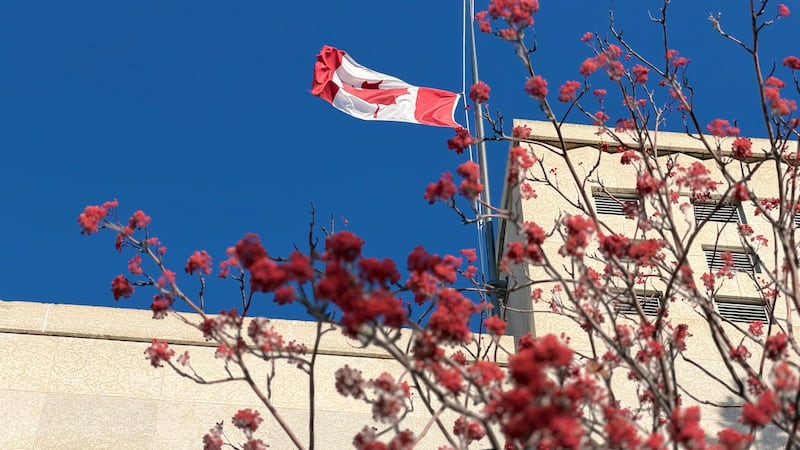
This year also marks the 100th anniversary of the founding of the Royal Canadian Legion — created in 1926 to serve as the main advocacy group for veterans’ benefits — and the 150th anniversary of the Royal Military College.
Hundreds of cadets came out to celebrate RMC’s anniversary.
“The cadets here and across Canada have grown considerably. There’s almost 70,000 cadets in the organization now across Canada,” said Dave Edwards, who works with the Connaught Cadet Training Centre in Ottawa. “It’s a great thing to see.”
This report by The Canadian Press was first published Nov. 11, 2026.
By Kyle Duggan, The Canadian Press
With files from Nick Murray, Alyssa Wheeler and David Baxter in Ottawa, Charlotte Glorieux in Montreal, Jordan Omstead in Toronto, Kelly Malone in Washington and Bill Graveland in Wainwright
Local coverage:
- Thousands of hand-sewn poppies mark cenotaph in Dartmouth, N.S.
- Hundreds of veterans’ graves preserved by volunteers in Dartmouth, N.S.
- Unknown no more: The story of forgotten U.S. Pvt. Éloi Arsenault
- ‘Righting a wrong’: Volunteers securing headstones for Manitoba veterans who never got one
- Montrealers pay tribute to war veterans at annual Remembrance Day ceremony
- Windsor to host Remembrance Day ceremony at City Hall cenotaph
- Road closures planned for Remembrance Day ceremony in London
- Remembrance Day ceremonies to honour CFB Wainwright fire victims