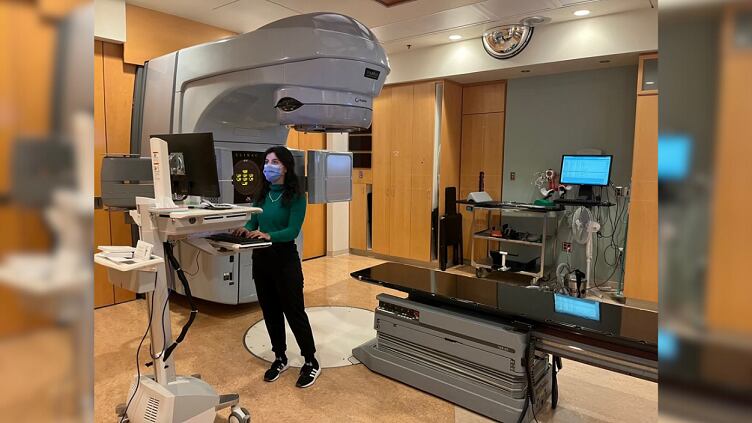
Cancer patients in Windsor-Essex now have access to even more advanced radiation treatment.
Windsor Regional Hospital has announced that a new radiation treatment linear accelerator (LINAC) officially went live this week.
The machine replaces one of the hospital’s aging radiation treatment units, and this is the second of three replacements planned as part of a major technology upgrade within the Windsor Regional Cancer Centre.
The hospital currently performs around 30,000 radiation treatments each year. In March 2025, a fourth LINAC was added. The addition of the fourth LINAC a year ago has allowed for the delivery of around 100,000 cancer treatments for radiation per year, 26,000 more per year than before the fourth LINAC was brought online.
The LINAC delivers high-energy radiation to destroy cancer cells while limiting damage to surrounding healthy tissue. The new technology also gives clinicians greater flexibility and accuracy when targeting tumours.
Laura D’Alimonte, Director of the Regional Cancer Program at Windsor Regional Hospital, says this is a huge milestone.
“So it means that we’ll be able to support with new technology, more enhanced care, delivery of radiation treatment. So more precise radiation treatment and care close to home.”
She says the upgraded equipment provides several technological improvements over the older machines.
“We’re able to move the patients in six degrees of freedom, rather than just in three degrees. We have enhanced imaging that helps guide where we want to deliver the radiation treatment. They have enhanced properties within the head of the machine that we can shape the radiation beam more precisely.”
D’Alimonte says the new technology will also help shorten treatment times for many patients.
“Rather than giving smaller amounts of radiation over an extended period of time, previously upwards of seven weeks of radiation treatment, now we can actually start minimizing that time that patients actually spend here, going down to five treatments total, but giving a larger dose per treatment.”
The final aging LINAC will be taken out of service next week, with the last replacement expected to begin treating patients by February 2027. The lifespan of the LINAC, according to Cancer Care Ontario, is approximately 12 years.
Once complete, all of the new machines will eventually be relocated to the new Fancsy Family Hospital.
The project was supported through a $30-million investment from the Ontario government, which also funded the hospital’s new cardiac catheterization lab, and through continued support from the Windsor Cancer Centre Foundation and its donors.