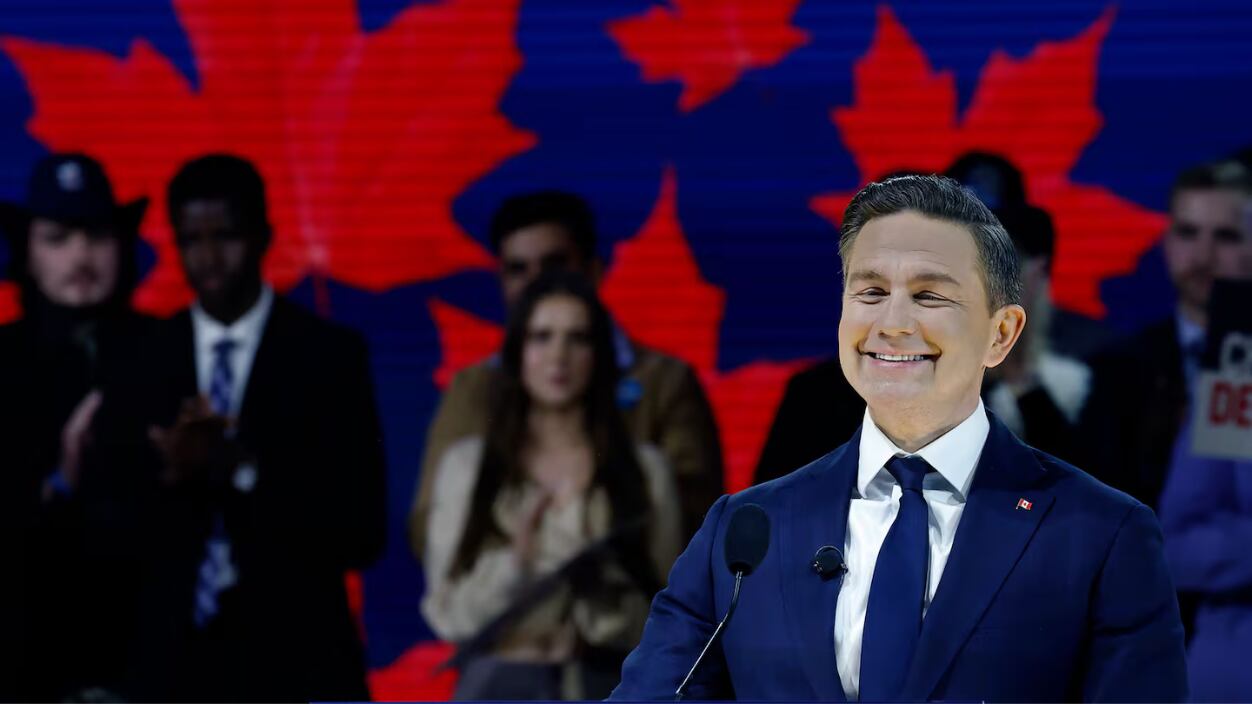
Conservative Leader Pierre Poilievre has handily passed the biggest test of his leadership since he took the helm of the party in September 2022.
After delivering a rousing election-campaign-style speech to a packed room of party members in Calgary Friday night, Poilievre received 87.4% per cent support in his leadership review.
The results were announced in a paper release shortly before 1 a.m. ET on Saturday. According to a party spokesperson, voter turnout was about 95 per cent.
“It’s great to be home in the beating heart of the West,” Poilievre told the crowd at the party’s annual convention earlier in the evening, after walking to the stage to the 1981 tune ‘Don’t Stop Believin’ by Journey.
Poilievre’s nearly 50-minute speech — interspersed with several standing ovations and chants of “Pierre” from the crowd — took aim at Liberal policies, laying blame for too-high taxes, youth unemployment and the cost of groceries.
“Simply put, Canadians cannot afford life under the Liberal government,” Poilievre said.
In his speech, which featured similar themes and issues he’s touched on in the past, Poilievre also pledged to “fight for” those who “are carrying the country on their back and feel under appreciated and overworked.”
“Out-of-control, open borders, immigration, has overwhelmed health care, housing and job markets,” he said. “Cancel culture and identity politics divide Canadians.”
“Separatist movements are re-awakened,” he added. “After 10 years of Liberal rule, Canada is more costly and crime-ridden, dangerous and dependent and divided than ever before.”
Poilievre touched on a wide range of issues, from foreign policy to separatism, immigration and national unity, and highlighted his proposed Canadian Sovereignty Act.
The plan calls on the government to “repeal the Liberal grown-blocking laws,” such as Bill C-69, the industrial carbon price, the oil and gas sector emissions cap, and “reward those who build,” in part by eliminating the capital gains tax on businesses that reinvest in Canada.
While the Conservatives picked up two dozen new seats in last April’s federal election, party rules dictate that leaders must face a review vote at the next convention following an election loss.
Poilievre also won the leadership contest handily with 68.15 per cent of the vote on the first ballot in 2022, coming in as members’ first choice in almost every riding after a contentious seven-month race.
The last such review by the Conservative party took place in 2005, after then-leader and former prime minister Stephen Harper lost the 2004 election. Harper received 84 per cent support at the time.
Asked by reporters on Parliament Hill in December — after one of his MPs crossed the floor and another announced he’d resign his seat — whether he’s confident he’ll get a good number in his own leadership review, Poilievre said: “Very.”
He had not, however, specified a threshold number of support he felt he needed to decisively unite and lead the party going forward.
In an interview on CTV Power Play with Vassy Kapelos on Monday, Conservative House Leader Andrew Scheer said he was “not going to prejudge or predict” a level of support that Poilievre might need to retain the confidence of the party.
“I believe that we’re going to get a good result,” he said. “I’ve spoken to members of caucus, members of our party, they recognize that with (Poilievre), we achieved historic levels of support.”
Scheer pointed to the party’s success in the last election under Poilievre’s leadership, despite the overall loss.
‘I believe so’: Tory campaign manager on possible 2026 election
Asked by CTV News chief political correspondent Vassy Kapelos during the network’s Conservative convention special on Friday night whether he anticipates there will be an election this year, Conservative campaign manager Steve Outhouse said: “I believe so.”
“I don’t think it’s necessary,” he added. “I mean, the prime minister has his mandate that he’s just got less than a year ago … and we have pledged our co-operation in the House to move things forward, to move from rhetoric to results, as the leader has said.”
But, Outhouse said, it may be difficult for Prime Minister Mark Carney to pass up on “the sheer politics” of the moment, to try and sustain his momentum from his highly praised speech at the World Economic Forum, and “try to use that Trump card, as it were,” referencing U.S. President Donald Trump.
“That’s the thing … in politics, a week is a lifetime, and we’re just going to continue to get out there and talk about the issues that matter to Canadians,” Outhouse said.
Poilievre behind on preferred prime minister question
Poilievre himself lost his longtime Ottawa-area seat in April to Liberal political rookie Bruce Fanjoy, but he won one back in a rural Alberta riding in an August byelection.
While the party maintained a 20-point lead in the polls for months leading up to the election, the Liberals’ replacement of former prime minister Justin Trudeau in favour of Carney, and the early days of the now-year-long trade war with the United States, have been largely credited with turning the tides come election day.
According to Nanos Research’s latest tracking numbers released on Jan. 27, the Liberals are leading at 39.2 per cent compared to the Conservatives at 35.2 per cent.
But, on the preferred prime minister question, the latest data from Nanos Research put Carney at 52.8 per cent, compared to Poilievre’s 24.8 per cent.
Conservatives set fundraising record
The Conservative Party of Canada, meanwhile, said Wednesday that it set a new Canadian political fundraising record in 2025, raising nearly $48 million through more than 327,000 donations.
“This generosity fuels our movement and helps us prepare to take on the Carney Liberals whenever the next election comes. I will never stop fighting for the millions of people the Liberals left behind,” Poilievre said in a statement.
The Liberal Party released its own annual fundraising numbers last week, saying they broke their own record with $29 million in 2025, which almost doubles what was raised in 2024.
-Written by CTV News' Spencer Van Dyk with files from CTV News’ Jeremie Charron, Stephanie Ha and Rachel Aiello