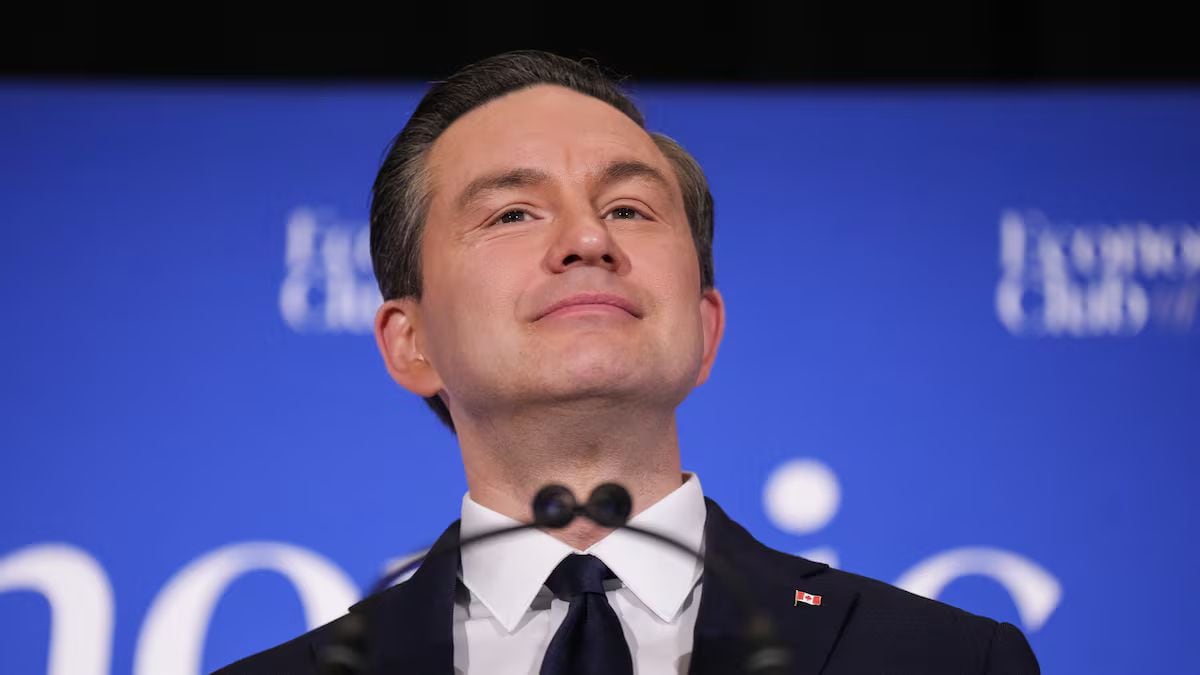
Conservative Leader Pierre Poilievre says Canada needs to create more leverage in its negotiations with the United States, and argues that despite the ongoing trade war between the two countries, Canada should not substitute the U.S. with China.
In a speech focused on becoming “stronger at home” to increase leverage abroad, Poilievre laid out his vision for Canada-U.S. relations in a speech at the Economic Club of Canada in Toronto Thursday.
“Economic strength is national strength,” he said. “Energy security is national security. Self-reliance is sovereignty made real. And sovereignty is not declared, it is built — decisively, deliberately and without excuses.”
The trilateral trade agreement between Canada, the U.S. and Mexico, known as CUSMA, is up for review this summer. American news outlets Bloomberg and The New York Times, however, are reporting U.S. President Donald Trump is mulling walking away from the deal entirely.
“We must divide the problem into what we control and what we do not control,” Poilievre said. “And most important of all, we cannot allow others to control us.”
“We must not allow President Trump to distract us from the work we need to do here at home,” he added, listing the need for low-cost energy, unblocking resources and homebuilding, a strong military, and digital sovereignty as elements of his plan to strengthen Canada’s leverage.
Conservative Leader Pierre Poilievre speaks at the Economic Club of Canada in Toronto on Thursday February 26, 2026.THE CANADIAN PRESS/Chris Young
Canada should not substitute U.S. for China: Poilievre
Amid a now-year-long trade war, Prime Minister Mark Carney has pledged to diversify Canada’s trading partners and insulate the economy from the United States.
Despite years of tense relations and concerns over foreign interference, Carney travelled last month to China to ink new trade deals with the global superpower. This week, he’s headed to India to do the same.
As Carney seeks to deepen ties with China — including announcing on his trip in January a deal on electric vehicles and agriculture tariffs — Poilievre argues that the Asian superpower should not become a substitute for Canada’s long-held relationship with the United States.
“Canada’s prosperity and security are inseparable from a stable relationship with the United States,” Poilievre said.
“That is why we should not declare a permanent rupture from our biggest customer and closest neighbour in favour of a strategic partnership for a new world order with Beijing — a regime the prime minister himself said was the biggest threat to Canada just a year ago,” he added, referencing Carney’s statement from last spring’s federal election campaign that China is the “biggest security threat” facing Canada.
Conservative Leader Pierre Poilievre chats with guests at the Economic Club of Canada in Toronto on Thursday February 26, 2026. THE CANADIAN PRESS/Chris Young
Poilievre pointed to Chinese interference in Canada, including electoral interference, as a reason to “make the mistake of confusing engagement with dependency.”
In Commissioner Marie-Josée Hogue’s report tabled last January following the Public Inquiry into Foreign Interference, China was listed as the “most persistent and sophisticated foreign interference threat to Canada.” India was the second.
“Canada should pursue diversified trade and global engagement,” Poilievre said. “Conservatives stand in favour of a free-trade agreement with India and deeper ties with other countries.”
“But diversification must be grounded in realism,” he added. “Not all partners are interchangeable.”
Poilievre in his speech also discussed the rise of China as a global power, arguing that “some of” Trump’s correction of the global trading system was overdue, but that the president erred in targeting Canada in the process.
“What President Trump says about Canada is wrong,” Poilievre said. “Our trade surplus does not represent exploitation of the United States of America. Quite the opposite.”
Poilievre said Trump’s threats to make Canada the 51st state are, whether “a joke or not,” “unacceptable,” adding there is “zero chance” of that happening.
“Canada and the United States have built probably the greatest partnership any two countries have ever built in the history of the world,” Poilievre said. “That partnership remains profoundly in the interests of both our peoples and both our countries.”
“It’s important to distinguish between governments and people,” he added. “Politicians come and go. People remain.”
Conservative Leader Pierre Poilievre disapproves the claims of Canada taking advantage of U.S. in trade and says Trump ‘ignores the sacrifices’ of Canadian troo
Poilievre takes aim at Trump
Late last month, Poilievre delivered a rousing election-campaign-style speech to a packed room of party members in Calgary, before securing 87.4 per cent support in his leadership review.
In that speech, however, he did not mention the U.S. president by name. In his keynote address on Wednesday, Poilievre took direct aim at Trump.
He argued Canada’s historic relationship with the United States, and that country’s position as the “gravitational centre of the global economy,” led to Canadian complacency.
His plan in negotiating a deal with the U.S., he said, would include:
- An end to steel, aluminum, autos, and lumber tariffs;
- A new tariff-free auto pact to protect North American production with shared protections against vehicles from China;
- Full exemption from “Buy America” frules; and
- A relaunch of the Keystone XL pipeline.
Conservative Leader Pierre Poilievre chats with guests at the Economic Club of Canada in Toronto on Thursday February 26, 2026. THE CANADIAN PRESS/Chris Young
“The best leverage we have is to be united here at home,” Poilievre said, adding he’s proposing an all-party CUSMA working group of parliamentarians “for the benefit of Canada above the benefit of party.”
Asked during the question-and-answer period following the speech — moderated by former deputy Conservative leader Lisa Raitt — why he does not appear more angry with the United States, Poilievre said the focus should be on what Canada can control.
According to the latest polling from Nanos Research released this week, Trump and U.S. relations is the second top issue amongst Canadians, following jobs and the economy. The issue has remained among the top three concerns for Canadians for more than a year.
Poilievre, meanwhile, continues to lag in the polls, with the Liberals several points ahead of the Conservatives, and Carney far exceeding him on the preferred prime minister question.
Three formerly Conservative MPs have also crossed the floor to the Liberals since November, with Alberta MP Matt Jeneroux joining Carney’s caucus last week after months of speculation.