The federal government is launching a new electric vehicle consumer rebate, and replacing the contentious EV sales mandate with new emissions standards, as part of a new strategy for the Canadian auto sector.
In a bid to make it more affordable for Canadians to purchase lower-emission vehicles, the government is launching a new five-year $2.3 billion EV affordability program, that will be available to consumers as of Feb. 16.
The program will offer individuals and businesses purchase or lease incentives of up to $5,000 for battery electric and fuel EVs, and up to $2,500 for plug-in hybrid models (PHEVs).
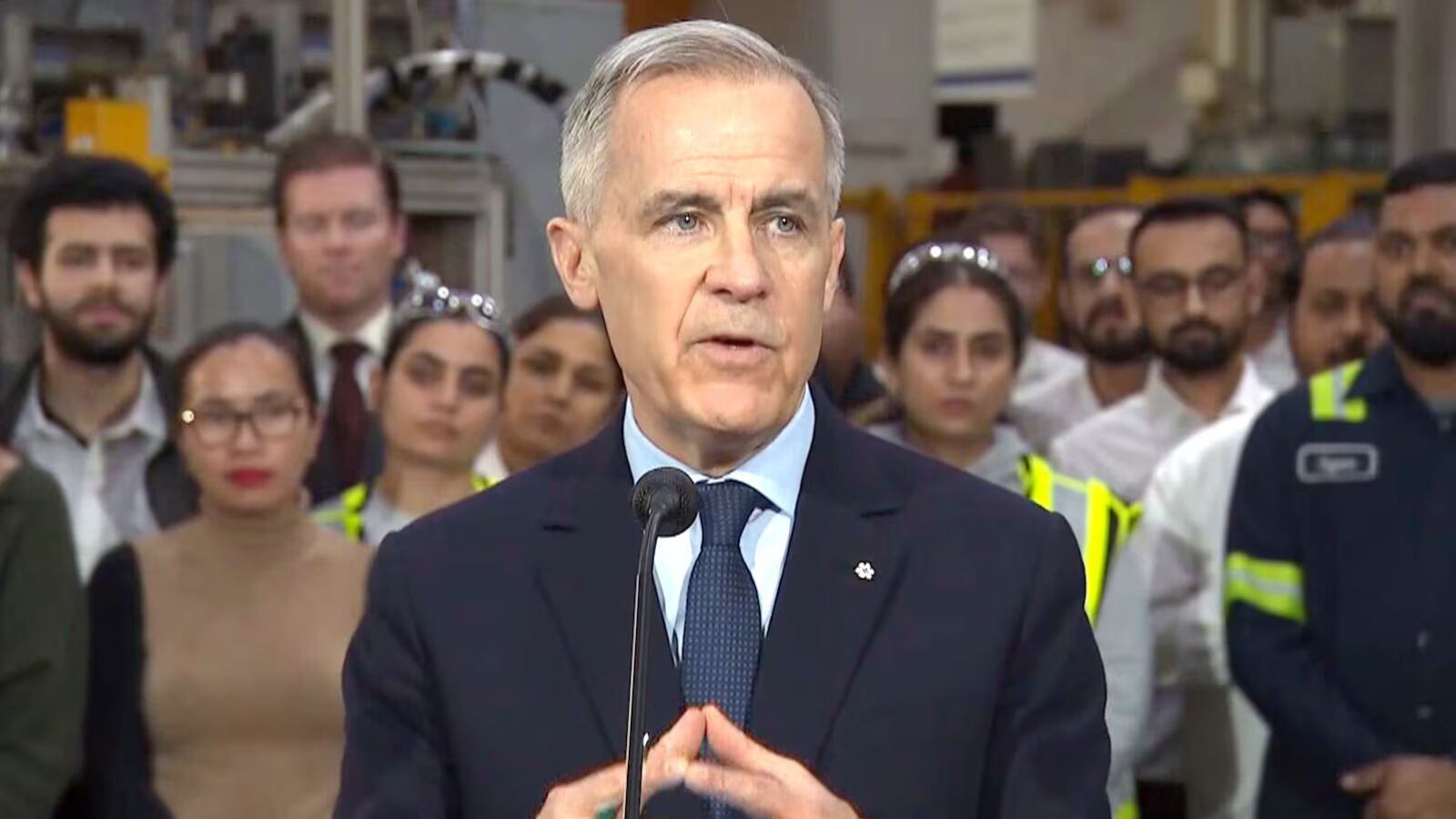
“The future of the auto industry is increasingly electric and connected,” Prime Minister Mark Carney said, unveiling of his government’s transformation plans at a parts manufacturing facility in Woodbridge, Ont.
“To remain competitive and realise our potential, we must develop the entire value chain for next-generation vehicles.”
These consumer rebates will only apply to vehicles that cost less than $50,000 and are imported from a country that has a pre-existing free-trade deal with Canada, meaning the coming allowance of a small number Chinese EV’s that caused acrimony between Carney and Ontario Premier Doug Ford won’t qualify for this benefit. The government estimates the rebates could result in an additional 840,000 new EVs hitting the road.
The motivations behind the series of measures announced Thursday, are to make the Canadian auto industry both less reliant on gas-powered vehicles, but also less dependent on the United States.
An electric vehicle is charged in Ottawa on Wednesday, July 13, 2022. THE CANADIAN PRESS/Sean Kilpatrick
EV mandate replaced
In alignment with these motivations, the Liberals have heeded calls from the auto industry and political critics to do away with the Trudeau-era EV sales mandate that targeted having EVs account for 100 per cent of Canadian sales by 2035.
Carney’s government is repealing the EV availability standard – which has been on pause since September – and in its place, introducing a new greenhouse gas emission standard for vehicle models years 2027-2032. By 2035, the aim is to have 75 per cent of vehicle sales be EVs, and 90 per cent by 2040.
This shift is to “rationalise emissions reduction policies to focus on outcomes that matter to Canadians,” according to officials from the federal transport, environment, and economic development departments who briefed reporters on a not-for-attribution basis on Thursday morning.
Though, when asked repeatedly those same officials could not say exactly what impact these measures will have on Canada’s overall emissions.
New auto worker support
The government is also installing new supports for auto workers through the industry’s transition period, with the aim of protecting jobs as the domestic sector tries to grow and diversify to new markets.
These include a new “work-sharing grant” to prevent layoffs, establishing a “workforce alliance” of industry, labour, and training partners. It will also provide employment assistance and reskilling funding for auto workers.
The sector currently supports more than 500,000 workers and contributes $16 billion annually to Canada’s GDP. Though, the ongoing Canada-U.S. trade war is threatening one of this country’s largest export industries and the jobs attached to it.
Currently, more than 90 per cent of Canadian-made vehicles and 60 per cent of Canadian-made parts are exported to the U.S. and the American tariffs are threatening 125,000 direct jobs.
And so, while noting automobiles may be the best symbol of how closely the Canadian American economies have been linked, Carney said he’ll maintain its 25 per cent counter-tariffs on auto imports from the United States to “ensure a level playing field.”
Prime Minister Mark Carney speaks to the media, Thursday, Feb. 5, 2026.
Rewarding Canadian-made
Behind the strategy is a commitment to allocate $3 billion from the “Strategic Response Fund” and $100 million from the “Regional Tariff Response Initiative” to help accelerate investments in Canada’s auto manufacturing sector.
With this funding, the government intends to identify Canadian suppliers and Canadian-made goods such as steel and aluminum that can be leveraged in the sector’s retooling efforts.
The federal plan also includes strengthening the national automotive remission framework to better reward companies that produce cars in Canada while requiring others to pay to access the Canadian market.
This change would see companies earn credits for investing in Canadian parts production or emerging technologies, as examples, while outside automakers looking to sell in the Canadian market would have to purchase credits.
The strategy also includes a few tax credits and incentives available to the sector, including a new “Productivity Super-Deduction,” that Carney said will “reduce Canada’s marginal effective tax rate on investment to 13 per cent. That’s more than four percentage points lower than in the United States.”
$1.5B for EV charging network
Noting that beyond affordability, range uncertainty and lacking availability of roadside chargers remain leading barriers to consumers making the switch to EVs, Carney’s strategy also promises $1.5 billion to improve the country’s EV charging network.
Flowing through the Canada Infrastructure Bank, the money will go towards “projects of national significance,” that would build out charging infrastructure more quickly across the country.
The prime minister said the motivation for putting more money into chargers, is to make it so plugging in your vehicle is as simple as stopping to fill your gas tank.
This funding is coming alongside a commitment to announce a new electricity strategy “in the coming weeks.”
Rachel Aiello, National Correspondent, CTV News