Ontario’s projected deficit for the coming year has nearly doubled, with the Ford government now suggesting that it will be $13.8 billion in the red in 2026-2027 amid “ongoing economic and geopolitical uncertainty.”
That is up from the $7.8 billion deficit it projected for 2026-27 in last year’s budget.
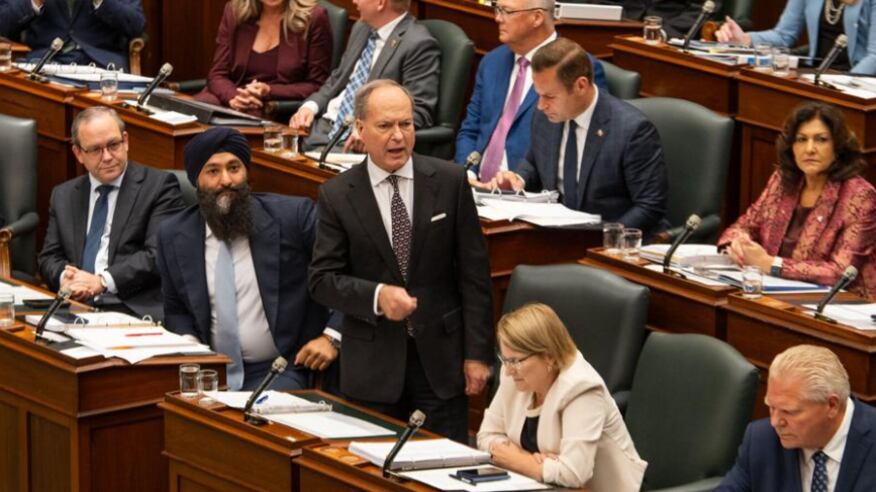
“The last year has been marked by significant change in the world around us,” Finance Minister Peter Bethlenfalvy said as he rose in the house to deliver the budget Thursday.
“Geopolitical forces that may have once felt distant have now reached our shores. Global economic and trade tensions, supply chain disruptions, shifting markets. Simply put — the world has changed, and we must change with it.”
The budget, titled “A Plan to Protect Ontario,” lays out some new spending on programs like home care, and post-secondary education, but also includes billions for tax breaks for buyers of new homes and small businesses.
Higher deficits for longer
Despite the government previously promising a return to balance sooner, Bethlenfalvy said the province has to recognize “this is the moment we’re in,” with higher government spending aimed at growing the economy while protecting key services like health care and education.
“Look across the all the provinces in Canada, virtually every one of them has increased their deficits because this is the moment we’re in,” he said.
The $244.2 billion budget includes $101.2 billion for health care, $40.8 billion for education and $14 billion for the post-secondary education sector.
A larger deficit of $6.1 billion is also projected for 2027-28, but the government says it expects to return to balance by 2028-29, with a small surplus of $600 million.
While the budget tells the story of an economy that has not been hit as hard as expected by tariffs, Ontario is continuing to project sluggish growth in the interim. Real GDP is expected to grow by one per cent in 2026, 1.7 per cent in 2027 and 1.8 per cent in 2028.
Overall, government revenue is down by around $100 million, mainly due to lower LCBO revenue.
Ontario’s net GDP-to-debt ratio for 2026-27 is projected at 37.7 per cent, slightly lower than the 38.9 per cent projected in last year’s budget.
Tax breaks
As announced earlier this week, the government will be temporarily removing the HST from the cost of new homes for all buyers who plans to live in or rent them out for residential purposes. The move will save homebuyers a maximum of $130,000 on homes valued at up to $1.5 million with smaller rebates for more expensive properties. The move is expected to cost the province $1.4 billion.
The budget notes that despite a recent slump, home resales are expected to rebound moving forward, growing by 9.1 per cent in 2026 and 5.6 per cent in 2027.
Small business corporate income tax will also see a cut, going from 3.2 per cent to 2.2 per cent as of July 1. The government says the cut will benefit more than 375,000 small businesses in the province, saving them an estimated $1.1 billion over three years.
$4 billion fund to invest in new industries to be managed by private partner
The latest budget largely continues on the commitments established in last year’s budget to fight U.S. tariffs through investments in infrastructure and large funds meant to support workers and businesses.
The government says part of its plan going forward will be to invest in new technologies and industries, that advance its “long-term economic and strategic priorities.”
It plans to do so by setting up a $4 billion “Protect Ontario Account Investment Fund.” The fund will invest up to $4 billion through a “best-in-class private investment manager,” a practice not normally used by the province, but which the government says will leverage “private sector expertise.”
Provincial officials say there will be a close eye on the fund to make sure the investments align with its priorities, things like defence, data centres and tech companies.
“We’ve got some of the greatest minds on the planet in technology right here in Ontario,” Bethlenfalvy told reporters.
“We provide a lot of funding for research, come up with great patents and intellectual property, and then investors come from around the world and buy up those patents, and move the offices to wherever, to the U.S., set up in Silicon Valley, move out of town. I want that to stay here in Ontario.”
The government will also be boosting a fund to support critical technologies like artificial intelligence (AI), life sciences, and advanced manufacturing by $107 million over three years, starting in 2027-27.
A competitive process is currently underway to select a manger.
At the same time, the government provided few specifics about how many parties have benefited from some of the billions of dollars in funds that were announced in last year’s budget.
Property tax money to flow straight to ministry
The budget includes $6.4 billion in additional funding for post-secondary education, as was previously announced. That funding boost comes at the same time the province shifts most student assistance from grants to loans and permits universities and colleges to raise tuition for the first time in years.
There’s also $66 million annually in order to give elementary school homeroom teachers spending cards to allow them to buy up to $750 in classroom supplies, a move that was announced several months ago.
While the government has promised significant changes to the education system, the budget does not lay those out or stipulate the role elected trustees will play going forward.
However, the budget does promise legislative changes that would see municipal education property tax remittances sent directly to the Ministry of Education instead of being collected by municipalities, starting in 2028.
School boards would continue to receive their funding, but would get it directly from the ministry. The province says the change will help ensure resources are directed to student learning instead of supporting “unnecessary administrative burden.”
The province is also promising $41 million over three years to offer school resource officer programs across the province.
More money for home care and autism
In terms of program spending, the province says it is boosting funding for the Ontario Autism Program to close to $1 billion annually, bringing it up to $965 million from $779 million last year. The province says the move will allow more kids to access clinical services, while strengthening capacity across the province.
Home care is also getting a big injection, with an additional $1.1 billion over three years to support patients with more home and community care services. The province says the move will extent service to thousands more patients.
Opposition says budget includes little help on affordability
In a statement, Ontario’s official opposition said the budget fails to meet the moment.
“This budget fails the test to meet Ontario’s priorities,” NDP Leader Marit Stiles said.
“Young people and families are struggling with sky-high rents, fewer opportunities, and soaring costs. Budget 2026 was an opportunity to deliver hope and relief for our province during a difficult moment.”
The party said the budget does nothing to meaningfully change the lives of Ontarians.
Interim Leader of the Ontario Liberal Party John Fraser echoed that message.
“The most important thing to people right now is affordability. Life is more expensive, and there is nothing in this budget to help families keep up,” Fraser said.
“There’s nothing to take the pressure off home heating and electricity, nothing to help with groceries, and nothing to make it easier to send your kid to college. In fact, they’re making it harder.”
Other commitments
- A previously announced commitment to ban the resale of live event tickets for more than face value
- The promise of a consultation to “strengthen protections for consumers who participate in rewards points programs”
- An additional $325 million to connect Ontarians to Primary Care
- Fieldwork on a feasibility study on Premier Doug Ford’s proposed Highway 401 tunnel will start in the spring
- Exploring standardizing rideshare guidelines across the province