


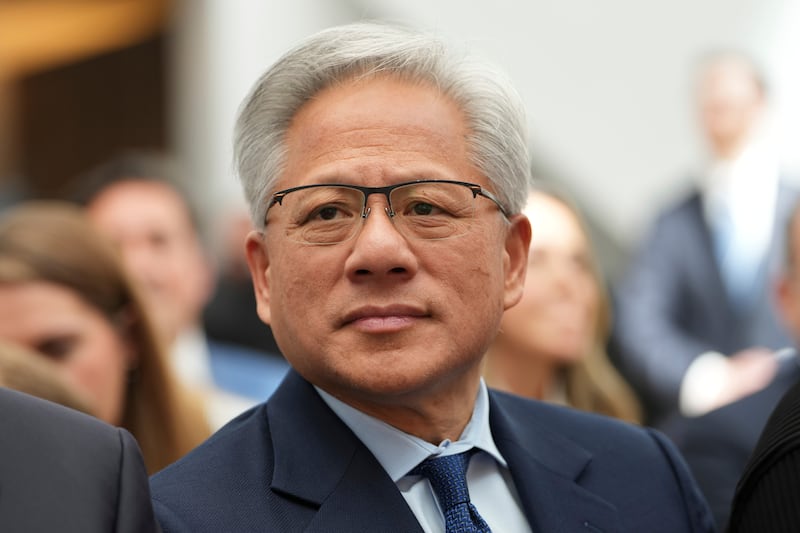
Jensen Huang has been reinstated as president and CEO of Nvidia, according to a press release from the company, reviving a stock that slumped after the co-founder resigned in scandal.
It appears U.S. President Donald Trump played some role in bringing Huang back into the fold, including by assuring the board that the executive did not represent a security risk.
Huang stepped down from the titan chipmaker earlier this month following reports of extramarital affairs, one of which raised national security concerns. The New York Times reported that Huang had an affair with a businesswoman U.S. intelligence suspects to be a Chinese spy, which Beijing denies.
The outlet and later others reported that Nvidia employees said Huang had another affair with an executive who reported to him directly — compounding calls for him to step down.
Despite that, Nvidia’s board wrote it “believes Jensen is the right person to lead NVIDIA, and that his reinstatement is in the best interests of our stockholders, employees, partners and customers,” board chair Harvey C. Jones said.
Huang, who was also quoted in the news release, wrote he’s taking on the role again with “the greatest humility.”
“I am honored to return to NVIDIA and lead one of the most consequential technology companies in the world at the beginning of a new industrial revolution,” he said, according to the release.
Stocks jump
The company’s stock was up roughly 30 per cent in premarket trading above the previous close following the announcement. It carried that momentum after the morning bell, pushing the stock price to around US$166 per share on Monday afternoon, up from US$125 on Friday.
The Dow Jones was up around two per cent shortly after open. The S&P 500 gained four per cent. The Nasdaq picked up six per cent.
Nvidia has a market capitalization of US$4.01 trillion.
The Canada Penson Plan, the national $866-billion retirement security fund, held 44,642,000 shares of Nvidia as of its most recent foreign equities report, released at the end of March. At that time, the fund evaluated its Nvidia holdings at $10.9 billion.
Trump’s involvement
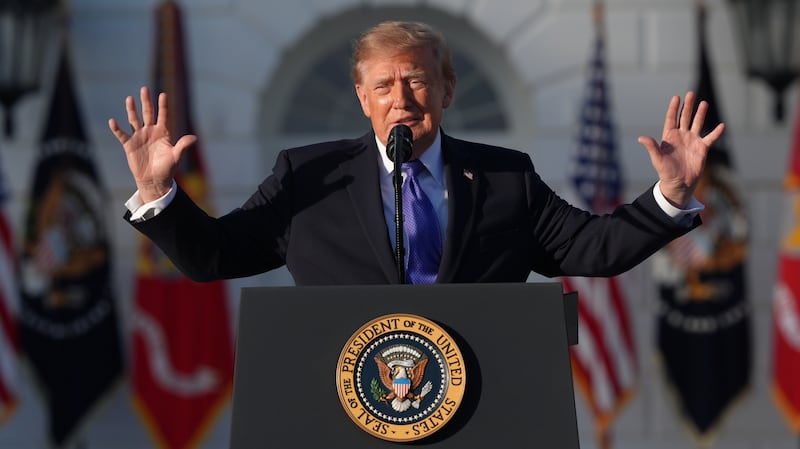
U.S. President Donald Trump posted a statement shortly after Nvidia put out its release. He said America needs Huang’s leadership at the company “in order to ensure the Success and Prosperity of not only the Company, but the American Economy.”
He also said his administration has no reason to believe Huang’s return poses a national security risk. The U.S. attorney general does not have any evidence suggesting Huang engaged in unlawful conduct, according to Trump.
Trump, speaking to CNBC Monday morning, said he had been in contact with Nvidia’s board “directly and indirectly” in the lead-up to Huang’s reinstatement. “I was talking to a lot of people,” he said.
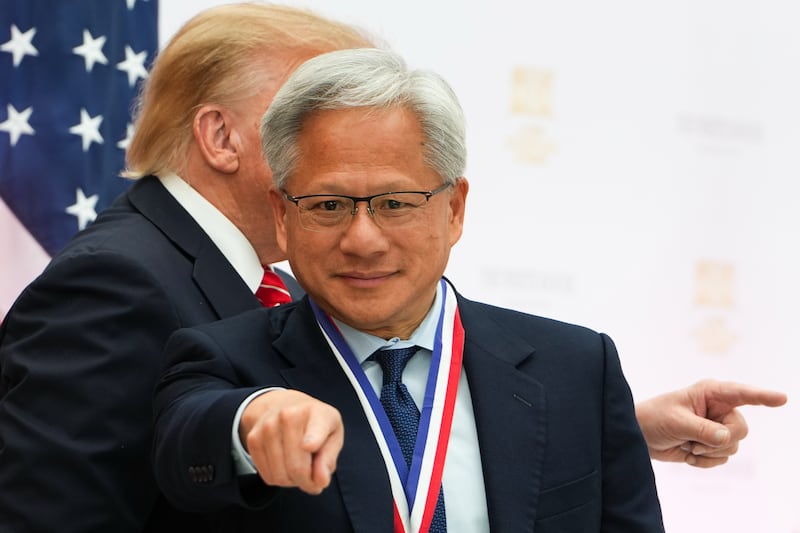
“This was a big decision, and the board decided to do what we wanted to do,” he said, after specifying that Huang did not represent a security risk to the United States.
“I felt he was innocent from day one,” Trump also told CNBC.
Trump bought as much as US$265,000 in Nvidia stock and sold as much as US$15,000 worth in September, weeks before reports surfaced of Huang’s ties to the alleged Chinese spy, according to a financial disclosure released last Thursday.
Asked why he as the president felt it was appropriate to get involved in the dealings of a publicly traded company, Trump said he was “doing it for the country.” Earlier, he likened American AI tech execs to a baseball team that lost its star player when Huang resigned.
“I talked to him last night. I said, ‘Now Jensen, just promise me one thing: You’re going to work hard.’ I spoke to him last night because I knew what was going on.”
Nvidia and Alice Huang
Alice Huang, also known as Huang Le, drew wide attention when the New York Times reported she had formed a close relationship with Jensen Huang and passed information to Beijing.
U.S. officials, the Times reported, had concluded Alice Huang was a Chinese spy who had been recruited to influence Nvidia to make its most advanced chips more available in China.
Nvidia’s chips are highly sought after for their capacity to train AI models. Jensen Huang has lobbied Washington to loosen limits on sales of Nvidia chips to China, according to The Associated Press. In January, he won Trump’s approval to sell Nvidia’s H200 chips to China, so long as those chips undergo a third-party review prior to export.
Alice Huang is a former executive at Singapore-based Megaspeed International, according to the AP.
A customer and cloud partner of Nvidia, Megaspeed has faced scrutiny in recent months, including from U.S. authorities, over allegations that it circumvented U.S. export restrictions to route large quantities of advanced chips to Chinese companies. Last December, it said there was “no evidence” of illicit chip transfers.
Earlier this month, according to The Associated Press, Megaspeed announced an internal investigation led by outside lawyers. The company told the AP that it runs a “legitimate and lawful business.”
During his appearance on CNBC, Trump was asked if he raised the spying concerns with Chinese President Xi Jinping during the two leaders’ meeting last week in Shenzhen.
Trump said he didn’t speak with Xi about it, but shared that the Chinese president considers Jensen Huang a “genius.”
AI and U.S. ‘hegemony’
Trump’s advocacy for Huang suggests the president sees AI as a central pillar of American leadership and his own post-presidential legacy, according to business analyst Ian Lee.
“To use slang English, he has bet the farm on the future of AI for the development of America and … the future of American hegemony,” said Lee, associate professor at Carleton University’s Sprott School of Business, during an interview on CTV News Channel.
Trump has taken a more protectionist stance on AI in recent days. On Friday, he announced he would impose sharp penalties on American companies that build data centres outside of the U.S.
Data centres are massive computing factories that serve AI companies and their products. Meta and Anthropic, two prominent companies in the artificial intelligence sector, have plans to build them in Canada.
With files from The Associated Press and Reuters