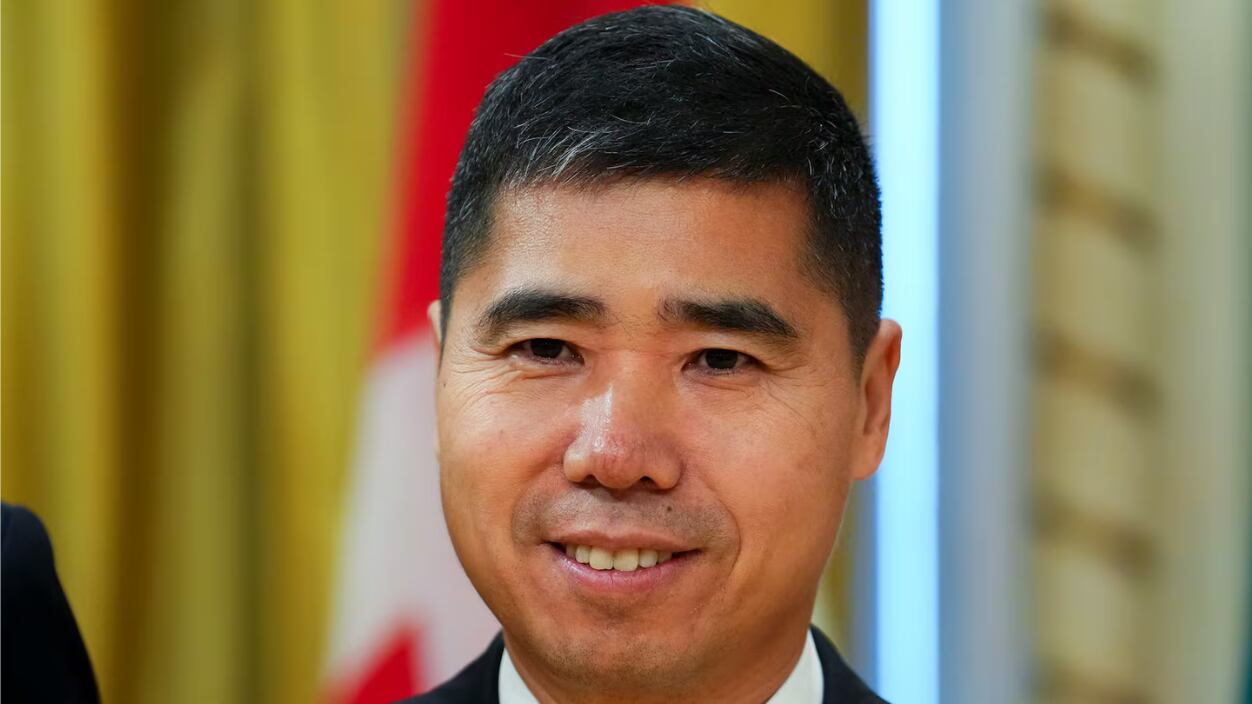
China will remove its tariffs on Canadian agriculture — including on canola products — if Canada scraps its levies on Chinese electric vehicles (EVs), that country’s ambassador says.
“If Canada removes the unilateral unjustified tariffs on Chinese products, China will also reciprocate accordingly,” Wang Di said through a translator in an exclusive interview with CTV Question Period airing Sunday. “And if the EV tariffs are removed, then China will also remove the tariffs on the relevant products of Canada.”
Canada has had 100 per cent tariffs on all EVs imported from China since last October, following the United States’ lead. It was a move aimed at protecting domestic manufacturing and national security, according to the federal government at the time.
The previous government also said at the time that China engages in the unfair subsidization of its EV industry, which allows it to flood the market with its product.
Canada also has 25 per cent tariffs in place on Chinese steel and aluminum.
China has since levied tariffs of its own on Canadian agriculture, including notably on canola products, with a 100 per cent tariff on Canadian canola oil and meal and a 75.8 per cent tariff on canola seed.
“The question you have raised touches the crux of the problems in our trade relations,” Wang told CTV Question Period host Vassy Kapelos, when asked whether China’s tariffs are a direct response to Canada’s EV levies. “China’s tariffs on Canadian agricultural products are a countermeasure against the EV tariffs and the unilateral unjustified tariffs on China’s steel and aluminum products.”
“If Canada is ready to correct this practice, China will also respond accordingly,” he also said.
The government is doing an “informal” review of its decision to impose the tariffs on Chinese EVs, though it wouldn’t provide specifics of the review.
Saskatchewan Premier Scott Moe is facing calls to support farmers in the province, The Canadian Press reported, with recent Statistics Canada data showing canola exports from the province to China have fallen drastically.
According to the data, Saskatchewan exported $96 million in goods to China in August, down 76 per cent compared to the same month last year. China is also Saskatchewan’s second-largest agri-food export destination, bringing in $3.7 billion in 2024.
Prime Minister Mark Carney, meanwhile, has signalled there are attempts to deepen the relationship with China in some sectors, such as agriculture and climate.
Late last month, on the sidelines of the United Nations General Assembly, he met with Chinese Premier Li Qiang, China’s second-highest ranking official.
It marked the highest political-level meeting between the two countries since 2018.
Two Canadian lawmakers — Moe and Kody Blois, parliamentary secretary to the prime minister — also recently returned from a visit to China amid the ongoing trade war.
Foreign Affairs Minister Anita Anand is also set to travel there this month.
When asked by Kapelos whether it would be naïve to deepen ties with China — considering it’s exploited Canada’s dependence on China as a primary export market for canola in particular — Wang said “the essence of bilateral trade cooperation and trade relationships is mutually beneficial and win-win.”
“If you look at the history of the past decades of China-Canada relationship, you will see that in trade, we have achieved fruitful outcomes, and these outcomes are the result of mutual respect and win-win, cooperation and mutual benefit,” Wang said.
“And what I want to say is that the trade disputes between China and Canada are not caused by China,” he added. “In China, we say ‘the one who tied the knot should be the one who unties it,’ so China is not the one to blame in this whole process.”
Conservative Leader Pierre Poilievre has said he opposes lifting the tariffs on Chinese EVs, though he’s called on the Liberals to do more to support farmers and get China to drop its levies on canola.
The relationship between Canada and China soured significantly in 2018 after Canada arrested Huawei executive Meng Wanzhou on behalf of the United States over bank fraud charges.
Days later, China separately detained Canadians Michael Kovrig and Michael Spavor over allegations of espionage — accusations they denied. Both men were eventually released after spending more than 1,000 days in a Chinese prison, not long after Meng herself was released from house arrest.
China ‘open’ to more Canadian oil: ambassador
As political debate persists over whether Canada should build another crude oil pipeline to B.C.’s west coast, Wang says China’s door for more Canadian crude oil “will be open.”
“China encourages more cooperation and investment in the energy sector between the Chinese companies and the Canadian counterparts,” Wang said. “As long as Canada’s energy products are market competitive, the door of the market of China will be open.”
Since the Trans Mountain pipeline expansion became operational in 2024, China has become Canada’s top customer for oil outside of the U.S., shipping an average of 207,000 barrels per day, according to tracking data by the information technology company Kpler.
Speaking to Kapelos, Wang emphasized “energy cooperation has already become a new growth point for China-Canada trade,” saying China imported 9.7 million tons of crude oil from Canada in the first eight months of 2025, which he said is “bigger than the number of the whole year of last year.”
You can watch Chinese Ambassador to Canada Wang Di’s full exclusive interview on CTV Question Period Sunday at 11 a.m. ET.
Written by CTV News' Spencer Van Dyk with files from CTV News supervising producer Stephanie Ha