


The deadly fire at an Alberta military base first began on an automatic grenade launcher range during routine exercises, officials say.
The original location of the fire meant crews could not properly fight it and instead monitored the flames before high winds would change the course of the evening.
Maj.-Gen. Wade Rutland of the 1st Canadian Division has said Saturday’s blaze began as a grass fire, but a violent windstorm sent flames racing toward soldiers training at Canadian Forces Base Wainwright.
He told reporters during a press conference Thursday in Edmonton that piecing together the minutes of the day will be ongoing and require the first accounts of soldiers who remain in hospital.
The Canadian Forces Base (CFB) Wainwright fire killed four and initially sent 39 wounded to various hospitals across the province.
Officials confirmed Thursday that number was down to 27 patients, with 13 in critical condition.
Canadian Forces Provost Marshal Brig.-Gen. Vanessa Hanrahan says some 30 military police are actively working to examine what happened on Sunday; investigating witness accounts, specialist expertise and reviewing the scene of the fire.
She emphasized that no evidence points to a criminal cause so far and no natural gas infrastructure was involved.
Military police are working closely with federal and external forces as the investigation was expected to take longer than what Rutland previously told the public would be about a month.
Three investigations were underway, led separately by the board of inquiry, military police and the chief medical examiner’s office, to ensure an “honest account” of the details, Rutland added.
Risk mitigation
Rutland says the investigation will also look at the military base’s risk mitigation and assessment of danger before the flames overtook the base.
Officials said the fire had spread at a rapid pace, bypassing fireguards and flying toward what’s called a pair’s range — where two soldiers work as a team to practise live-fire exercises.
Previously, officials had said the fire had leapt to the section attack range.
“The nature of military service,” he added, is to train for realistic combat environments, meaning soldiers train daily in risky environments with the necessary precautions.
“The fact that military responsibility carries risk does not lessen the fact that we must find out what happened.”
Aftermath and community response
In the minutes after fire broke out, Rutland credited soldiers on the base for not hesitating to get their teammates to safety and emergent medical attention.
He recommends donating to accredited military non-profits to continue pouring into the injured soldiers and asks those interested in attending public funerals to be patient out of respect for grieving families.
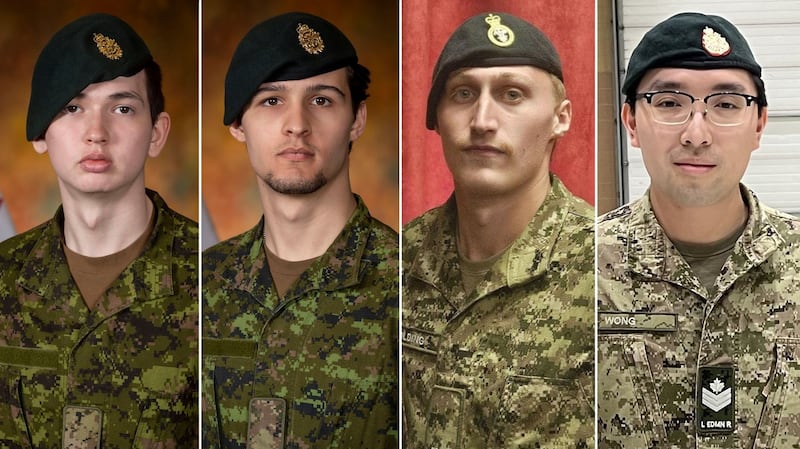
Dr. Sayeh Zielke, CEO of Acute Care Alberta, said the Albertan and cross-country response from medical professionals after the fire “was nothing short of heroic.”
Roughly 150 people attended a vigil late Wednesday at a church in the nearby town of Wainwright, Alta., southeast of Edmonton.
Prayers were said, songs were sung and the names of those killed were read aloud, followed by a moment of silence.
Mayor Bruce Pugh says the last few days have been tough, but activities at the base have started to return to normal. The entire battalion is expected to redeploy in the coming days.
With files from the Canadian Press