


OTTAWA - Manitoba Premier Wab Kinew said he wishes Canada pushed harder against the U.S. in trade negotiations, but that he understands where Prime Minister Mark Carney is coming from in his bid to seal a deal.
Carney briefed the premiers on Wednesday about the agreement with the U.S. to stop punishing new tariffs and address longstanding trade irritants on both sides of the border.
Kinew said he’s still waiting for some details, including the exact nature of what tariffs will be on steel and aluminum, but he said doesn’t think Canada should concede much because Canada has “the upper hand.”
“I think we should fight,” he said. “I think Donald Trump is very weak. I think America is weaker around the world today than it was a year ago. He’s about to get slaughtered in the midterms. And the cost of living is the number 1 issue. And he is completely out of touch with the cost of living of Americans.”
Still, Kinew said he’s on Team Canada. The premier said Carney “effectively” told them there would be no deal without a pledge to put U.S. alcohol back on the shelves.
“I wouldn’t say that he was begging us, but what is a step before begging? So I get it from his perspective,” Kinew said during a press conference in Winnipeg Thursday.
All provinces and territories pulled U.S. booze in 2025 after U.S. President Donald Trump began hammering Canada with tariffs, and all but Alberta and Saskatchewan still have their bans in place.

Newfoundland and Labrador Premier Tony Wakeham, the current vice-chair of the premiers’ group known as the Council of the Federation, said in the call with Carney all premiers agreed to return U.S. booze to their shelves.
Not all premiers have confirmed that though — notably Ontario Premier Doug Ford, whose province both used to be the biggest customer for U.S. booze and has the most to lose if steel and auto tariffs aren’t lowered enough.
Ford has not yet said anything publicly about the trade deal.
Yukon Premier Currie Dixon said when the U.S. deal is done the Yukon will lift its ban on American alcohol, and Northwest Territories Premier R.J. Simson said he’d consider it.
Simpson, who recently took over as chair of the Council of the Federation, said while some provinces stand to be hit harder than others, he isn’t worried about cracks in the “Team Canada” approach.
“Ontario, with steel, that’s a big issue for them. And so it’s going to come down to that and how they feel they’re being treated in this, Simpson told The Canadian Press. “But if it’s good enough for Doug Ford, it’s good enough for me.”
Quebec Premier Christine Frechette said in French she had a “long call” with Carney Thursday.
“I had several answers to questions I had asked. Now, we need to analyze those answers and evaluate the impact it represents on Quebec’s economy. Once that analysis will be done, I will come back to you with my position,” Frechette said in French during a press conference in Roberval, Que.
Kinew said he’s considering Carney’s request on U.S. booze but said that doesn’t mean he thinks people should buy it.
“When we put the American booze back on the Liquor Mart shelves, Canadians, leave it there. Spend your money on Canadian products that are going to employ people in our country and that have an administration that respects Canada,” Kinew said.
Returning U.S. liquor to Manitoba’s shelves is expected to take a few weeks, should it happen, in order to get labels printed with both French and English, Kinew said.
U.S. President Donald Trump announced Tuesday that he was pausing the new tariffs on Canada for three days pending the finalization of a new trade deal.
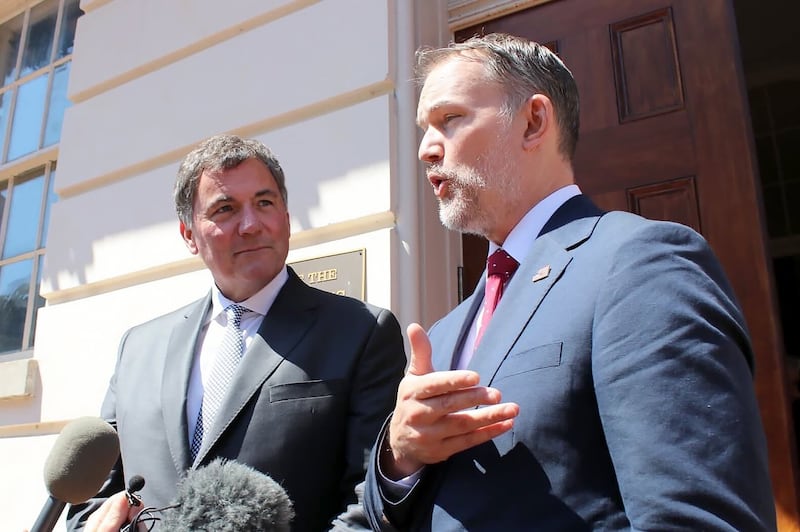
Canada-U.S. Trade Minister Dominic LeBlanc returned to Washington on Thursday to meet again with U.S. Trade Representative Jamieson Greer to continue that work.
Details of the deal are scant but it is expected to address U.S. tariffs on steel, aluminum, lumber, and autos, some U.S. concerns about limited access to Canada’s dairy market, as well as Canada’s retaliatory tariffs on autos and provincial bans on U.S. alcohol imports.
LeBlanc and Canada’s chief negotiator Janice Charette did not respond to reporter questions when they arrived for their meeting with Greer, but LeBlanc said “we brought some friends from Ottawa.”
Mark Wiseman, Canada’s ambassador to the U.S., and Marc-Andre Blanchard, Carney’s chief of staff, joined LeBlanc and Charette.
Carney also spoke with Mexican President Claudia Sheinbaum Thursday and the two talked about evolving North American trade, according to a readout issued by his office. Both leaders stressed the importance of renewing the Canada -United States-Mexico Agreement, or CUSMA, as soon as possible.
Bloc Québécois Leader Yves-Francois Blanchet sent a letter to Carney Thursday morning demanding federal opposition leaders be consulted on a potential deal with the U.S.
Conservative Leader Pierre Poilievre said Wednesday he has not received a briefing on the potential deal nor the negotiations.
Carney has yet to speak publicly about the deal, but in a statement released Wednesday he said the new deal reinforces and builds on Canada’s existing trade advantages with the U.S.

By David Baxter
With files from Catherine Morrison and Nick Murray in Ottawa, Ian Bickis in Winnipeg and Kelly Malone in Washington.