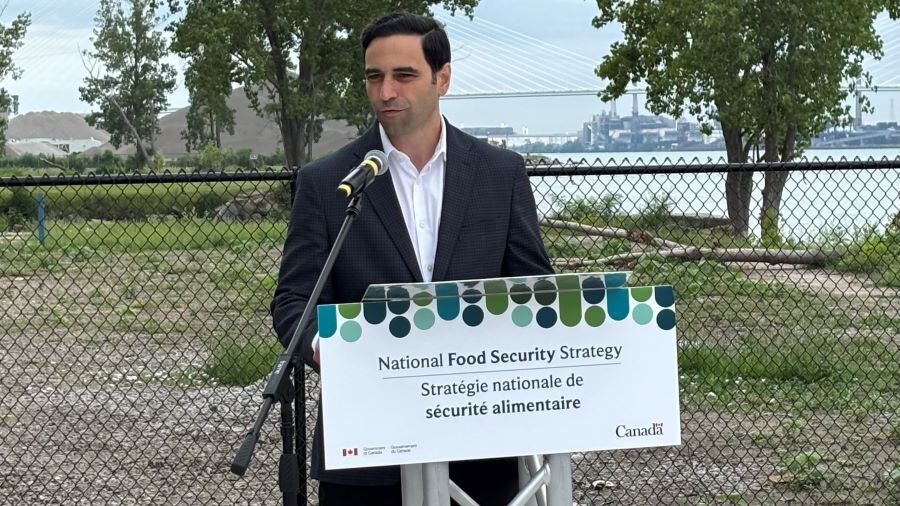
The federal government is trying to highlight the importance of Canada’s National Food Security Strategy, and the role Windsor-Essex can play.
London Centre Liberal MP Peter Fragiskatos was at the Port of Windsor Monday to highlight the objectives and funding laid out in the strategy announced in early June.
It includes more than $3 billion in investments over ten years to open the market for independent retailers, boost domestic food production, and build a stronger, more independent, and more affordable food system for all Canadians.
The government investment includes $1 billion in food infrastructure to build new and expanded food terminals and hubs-helping independent grocers buy and move competitively priced products without relying on large retail chains.
The government will also invest $750 million to drastically expand year-round Canadian production of fruits and vegetables, including through greenhouses, vertical farms, and other enclosed growing spaces.
MP Peter Fragiskatos says southwestern Ontario is a breadbasket for the country.
“This region in particular, when you look at greenhouses, has tremendous potential. There’s $750 million attached to this national food strategy that we are putting forward. The results will be, I think, that you will have businesses that will be able to take advantage of that,” he says.
Fragiskatos says there is a chance for local businesses to take advantage of the programs and boost their production to provide more food for Canadians.
“There is real tangible support made available now by the federal government. The $750 million figure I just gave for greenhouses. There is support, low-interest loans that would be available for young farmers who wish to pursue a career in farming,” he says.
There will be a $1 billion agri-food project finance fund through Farm Credit Canada (FCC) to provide seed capital financing for businesses to expand food processing capacity.
A $150 million Food Security Fund will be established to help small and medium-sized businesses upgrade their equipment to grow, produce, and process more food in Canada.
Fragiskatos says families are spending, on average, $800 a month at the grocery store, which is not an acceptable situation.
“There is support to put in place regional distribution centres, food hubs for example, so we can improve the way food gets to grocery stores and on to tables. This is a food strategy that has been long in the making. We need it; we need it now because of the challenges Canadians are facing,” he says.
As part of the strategy, the government also plans to modernize key regulations, speed up approvals for seeds, feed, fertilizers, and veterinary products, and reduce backlogs in the system to support higher productivity and a more stable food supply.