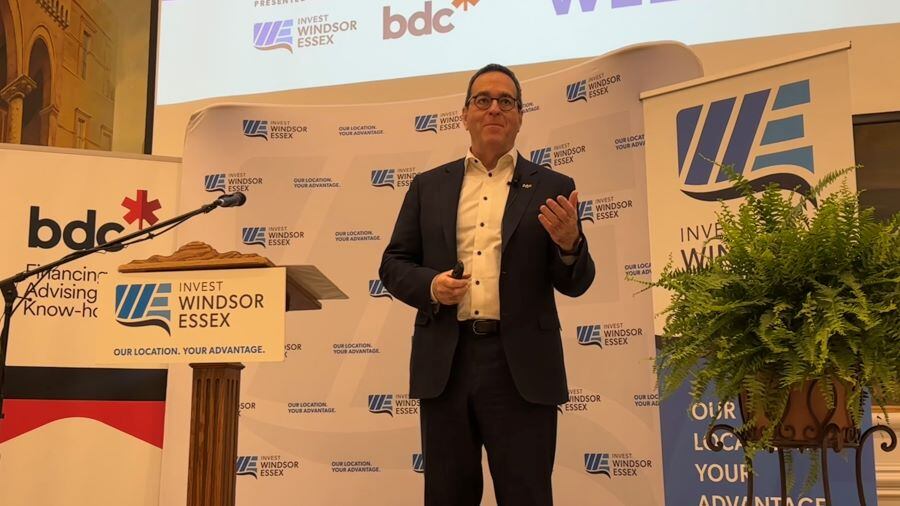
The chief economist for the Business Development Bank of Canada believes Windsor-Essex is "at the heart" of everything that Canada is trying to do in building its defence industrial sector.
BDC Chief Economist Pierre Cléroux spoke Thursday in Windsor at an event hosted by Invest WindsorEssex.
Cléroux told the crowd that the world is different now, with a new world order emerging after U.S. President Donald Trump began imposing tariffs on countries around the world and NATO member countries, including Canada, investing more in defence.
Negotiations around the Canada-U.S.-Mexico Agreement are set to begin this summer, but no matter what the outcome around the trade deal, he believes it will be harder to access the U.S. market in the future.
That's why he's pointing to increased defence spending by the federal government, noting that Ontario is well positioned to seize opportunities in defence and military spending because of its strong manufacturing sector but that it's up to businesses to pivot and take the opportunity seriously.
Cléroux says we need manufacturers to grow Canada's defence industry, and there's a strong manufacturing base here in Windsor that can benefit from that spending.
"The military is buying parts; they are buying clothing, boots, and tents. So it's not only tanks and fighter jets; it's much more than that. To be part of the supply chain doesn't mean you're making tanks, but you can make parts that will be part of that supply chain," he says.

Prime Minister Mark Carney announced in February a Buy Canadian plan for supplying the military and growing Canada's domestic defence industry.
The $6.6 billion strategy aims to help small and medium-sized Canadian businesses break into the defence industry and shift spending decisions to prioritize made-in-Canada equipment, instead of relying on foreign military contractors such as American firms.
The plan is aiming to spur 125,000 jobs over a decade.
Cléroux says the government wants to build a Canadian supply chain for the defence industry.
"We're looking for companies that are already in that supply chain but also companies that are not. They can pivot; if they can produce parts for the auto sector, they can probably build parts for the military as well," he says.
Cléroux says Windsor-Essex already has a strong manufacturing base, and it's exactly what's needed to build a supply chain in Canada.
"Windsor is at the heart of this transformation that the Canadian government is trying to do. There is going to be a lot of investment in construction, mining, and manufacturing. Windsor is manufacturing so Windsor can benefit from that change," he says.
Cléroux says the economy will be slow this year, but he does not believe Canada will go into a recession in 2026 with consumer consumption driving the economy even though business investment and exports slow due to the trade tensions with the U.S.
BDC is dedicated to the development of Canadian small and medium-sized enterprises and supporting Canadian entrepreneurship by providing financial and consulting services.
With files from the Canadian Press